Single Member LLC Operating Agreement Template and Clauses
Nick · Published 21 August 2026
Maya formed her LLC, obtained an EIN, and started billing clients. She skipped the operating agreement because she was the only owner. The omission became expensive when a bank questioned whether her EIN matched her authority, a landlord refused to recognise the company's lease, and a claimant argued that Maya had never maintained a real separation between herself and the business.
That situation is avoidable. A single-member LLC operating agreement is a private governance record that explains who owns the company, who can bind it, how money moves, and what happens if the owner becomes unavailable. It isn't filed with the state, but it can become one of the most important documents in the LLC's records.
Table of Contents
- What a Single Member LLC Operating Agreement Does
- State Requirements and Where the Agreement Is Mandatory
- Front Matter Clauses Every Template Needs
- Operations, Distributions, and Tax Treatment Clauses
- Veil Protection, Successor Planning, and Dissolution Clauses
- Tax Elections and How the Agreement Supports IRS Treatment
- Adapting the Template to Your State
- Executing, Storing, and Updating the Agreement
- Quick Reference and Common Questions
What a Single Member LLC Operating Agreement Does
A solo founder can form an LLC, obtain an EIN, and start taking payments without this document. That approach creates avoidable problems when a bank questions signing authority, a landlord challenges the company's lease, or a claimant argues that the owner never treated the business as separate.
The Articles of Organization create the LLC through the state filing process. The operating agreement governs the company after formation, including where state law makes it optional. Nolo's guidance on single-member LLC operating agreements explains that the document is generally kept internally while recording ownership, management authority, profit handling, and dissolution rules.
For a solo founder, four clauses do the work that matters:
- It identifies the separate entity. The agreement states that the LLC conducts the business and owns its assets and contracts. The member owns an interest in the LLC, not each company asset personally.
- It fixes authority. It names the sole member and authorizes actions such as opening accounts, signing contracts, borrowing money, hiring workers, and dealing with third parties. Clear authority can prevent a bank from rejecting a transaction or questioning who may bind the company.
- It creates evidence. A signed agreement helps show that the owner intended to operate a distinct legal entity, which supports the liability shield if a court examines veil-piercing issues.
- It closes succession gaps. Instructions for incapacity, death, transfer, or winding up give the company a defined path when the owner cannot act.
The agreement does not protect an owner who pays personal expenses from the company account, signs contracts only in a personal name, or neglects business records. It works with those practices by setting a written operating standard.
Practical rule: Treat the agreement as a governance record, not a form you download and forget.
Without an agreement, state default rules fill gaps. They may conflict with the founder's intended authority, distributions, succession plan, or winding-up process. Thomson Reuters' overview of operating agreements describes the document as the governance layer for practical questions that statutes do not answer.
Banks, lenders, landlords, and purchasers may request it. Keep it signed, dated, consistent with the Articles of Organization, and stored with the LLC's records.
State Requirements and Where the Agreement Is Mandatory
State rules differ, and the distinction matters. California, Delaware, Maine, Missouri, and New York require an operating agreement even for a single-member LLC. In the other states, the statute generally makes the agreement optional and supplies default rules when the owner has not adopted one.
Those five states are the compliance priority. Prepare and sign the agreement before conducting business there. In every other state, adopt one anyway. A bank may request it before opening an account, a lender may review it before extending credit, and a court may examine the company's records when evaluating whether the owner respected the LLC's separate identity.
| State | Status | Statutory basis | Practical trigger |
|---|---|---|---|
| California | Mandatory | State LLC rules require company governance in written form | Formation records and banking |
| Delaware | Mandatory | State LLC rules recognise the operating agreement as the company's governance instrument | Banking, lending, and contract authority |
| Maine | Mandatory | State LLC requirements call for an operating agreement | Formation compliance |
| Missouri | Mandatory | State LLC requirements call for an operating agreement | Formation compliance and records |
| New York | Mandatory | State requirements apply to LLC operating agreements | Formation compliance and third-party review |
| Other states | Statutorily optional | State default rules apply when the owner has no agreement | Banks, lenders, courts, and internal records |
The agreement usually stays private rather than being filed with the Secretary of State. Privacy does not make it casual. A signed document can establish the owner's chosen governance terms and give the company a written record when a bank, contracting party, or court asks how it operates.
Virginia shows why a generic template can miss state-specific requirements. Virginia law recognises that a single-member LLC agreement may include any signed writing related to the company's affairs, as shown in Virginia's LLC statute. That flexibility supports a focused agreement, but it does not answer every state's filing, content, or execution rules.
Check the governing law before signing, after registering the LLC in another state, and whenever the business changes materially. An agreement that satisfies one state's practice may leave a different state's mandate or default rule unaddressed.
Front Matter Clauses Every Template Needs
The first pages should remove ambiguity, not create it. Before adapting a template, compare its legal name, principal office, registered agent, formation state, and purpose with the Articles of Organization. Sprintlaw's checklist of common single-member LLC agreement mistakes emphasises that those identifiers should match.
Formation and identity
Formation recital
“The Company was formed as a limited liability company under the laws of the State of [State] on [date].”
This prevents a mismatch between the agreement and the public formation record, a problem that can delay bank review or create confusion in litigation.
Member identification and ownership
“[Full legal name] is the sole member of the Company and owns one hundred percent of the membership interests.”
This states the ownership position directly. Don't leave a blank ownership schedule in a single-member document or copy a multi-member voting formula that suggests another person has an interest.
Purpose
“The Company may conduct any lawful business for which a limited liability company may be organised in [State], including [brief description of principal activities].”
A broad lawful-purpose clause reduces the chance that a new service requires an unnecessary amendment. Keep the description accurate, but don't write a purpose so narrow that ordinary expansion becomes a governance problem.
Authority and location
Effective date and term
“This Agreement is effective on [date] and continues until the Company is dissolved and wound up under this Agreement or applicable law.”
This gives the document a clear start date and avoids an unexplained gap between formation and governance.
Registered agent and principal office
“The Company's registered agent is [name], located at [address], and its principal office is [address].”
These details help reconcile the agreement with state filings and bank records. Update them when the company moves or changes its agent.
Single-member authority
“The Company is member-managed. The Sole Member has exclusive authority to manage the Company and may sign contracts, open and control bank accounts, borrow money, hire service providers, and otherwise bind the Company.”
This prevents a bank or contracting party from asking who has signing power. If you need a branded document for review or circulation, a browser-based PDF viewer for branded business documents can present the signed file without changing its legal content.
Avoid boilerplate that invents managers, requires meetings you can't hold, or refers to votes among members who don't exist. A short, accurate agreement is stronger than a long document describing a fictional organisation.
Operations, Distributions, and Tax Treatment Clauses
Operational language matters most when someone asks you to prove what happened to money or property. A good template records the mechanics plainly and leaves no doubt about who controls the records.
| Clause | Sample language | Failure it prevents |
|---|---|---|
| Capital contributions | “The Sole Member shall contribute [amount] in cash to the Company by [date]. Any non-cash contribution shall be described in a written contribution record.” | Unclear funding history and undocumented transfers |
| Distributions | “Subject to applicable law and the Company's obligations, the Sole Member is entitled to the Company's net cash available for distribution, with distributions made at the Sole Member's discretion and reviewed no less than annually.” | Vague cash-flow expectations and conflicts with default rules |
| Tax classification | “Unless the Company makes a valid tax election, it shall be treated as a disregarded entity for federal income tax purposes.” | Confusion between legal governance and tax classification |
| Books and records | “The Company shall maintain its books, bank statements, tax records, contracts, and contribution records at [location or secure system], and the Sole Member may inspect them.” | Missing evidence during bank, creditor, or tax review |
Document pre-existing equipment, intellectual property, or other assets transferred to the LLC. A vague statement that “all business property” belongs to the company doesn't prove when a specific asset moved, who contributed it, or how the transfer was recorded. A contribution schedule, bill of sale, assignment, or similar record should support the agreement.
Distributions deserve equal precision. Don't write “profits will be distributed as appropriate” and stop there. State who receives available cash, whether reserves come first, and how the owner authorises each transfer. The agreement should match actual bank activity.
The IRS treatment is separate from the internal record. The IRS explains that a default single-member LLC is generally a disregarded entity for federal income tax purposes. That classification doesn't replace clauses on ownership, authority, contributions, records, or dissolution.
Veil Protection, Successor Planning, and Dissolution Clauses
The clauses that matter most are often missing from free templates because they address uncomfortable events. A creditor, divorce, incapacity, death, or failed business can expose weaknesses that never appeared during ordinary trading.
Keep the company separate
Use direct language:
“The Company shall maintain one or more bank accounts in the Company's name. Company funds shall not be used to pay the Sole Member's personal expenses, and the Sole Member shall not use personal accounts as the Company's regular operating accounts.”
This is the core practical protection for a one-owner company. Open the account in the LLC's legal name, use it consistently, keep receipts, and sign contracts as the company. The agreement supports those actions, but it can't cure repeated commingling.
An indemnity clause should also be narrow and sensible:
“To the fullest extent permitted by law, the Company shall indemnify the Sole Member for liabilities and expenses arising from good-faith actions taken on behalf of the Company, except for fraud, wilful misconduct, or conduct for which indemnification is prohibited.”
That language supports good-faith business conduct without pretending the owner can contract away every personal wrong.
Preserve continuity
The successor clause should identify the person or process that takes control:
“The Company shall not dissolve solely because of the death or incapacity of the Sole Member. Upon that event, [named successor or authorised representative] may act to preserve the Company, subject to applicable law and the transfer provisions of this Agreement.”
Name a successor who understands the business, and coordinate the clause with your will, trust, power of attorney, insurance arrangements, and state law. The agreement alone may not transfer every asset or membership interest.
Control changes and winding up
“The Sole Member may amend this Agreement only by a written instrument signed and dated by the Sole Member.”
“Upon dissolution, the Company shall wind up its affairs under a written plan, satisfy liabilities, collect receivables, dispose of assets, and distribute remaining property as required by law.”
These provisions prevent informal changes and provide a record of the closing process. Free templates commonly omit succession detail, asset separation language, and a usable wind-down plan. Those omissions become costly when a family member, lender, or court must reconstruct your intentions.
Tax Elections and How the Agreement Supports IRS Treatment
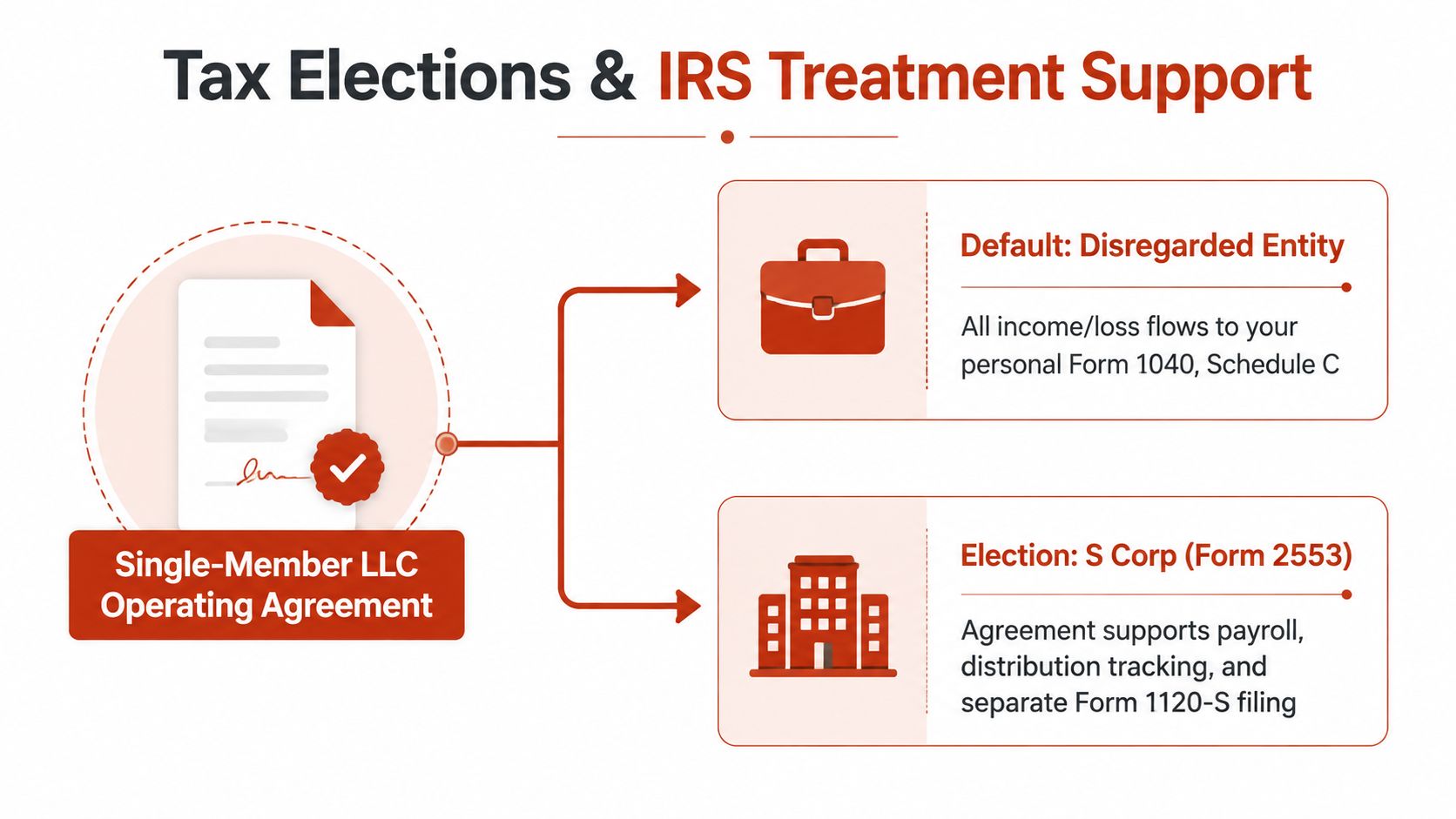
A solo founder can run an LLC correctly under state law and still create federal tax problems through sloppy documentation. The agreement should state the intended tax classification, identify who handles filings, and preserve a clear record if the owner later chooses a different election. The IRS description of single-member LLC taxation explains the default federal treatment.
Unless the owner makes a valid election, a single-member LLC is generally treated as a disregarded entity for federal income tax purposes. Business activity is reported on the owner's federal return, commonly through Schedule C of Form 1040. Use language such as:
“Unless the Company files a valid election to be classified otherwise, the Company shall be treated as a disregarded entity for federal income tax purposes. The Sole Member is responsible for coordinating the Company's federal, state, and local tax filings.”
A Form 2553 election can place the LLC under S corporation tax treatment. The agreement should acknowledge that possibility without pretending the contract creates the election:
“The Company may elect and maintain S corporation tax treatment if the Sole Member determines that the election is appropriate and valid. The Company shall maintain records supporting payroll, distributions, and the required corporate tax filings.”
Add a separate services clause:
“The Company shall determine and pay compensation for services performed by the Sole Member in accordance with applicable tax requirements and professional advice.”
Adding a spouse requires a new tax review. Community-property rules can affect federal treatment, while a second member changes the classification analysis. Amend the agreement to record the ownership change, effective date, contribution, management rights, and tax-reporting responsibility.
The agreement cannot force IRS acceptance. Inconsistent language about distributions, allocations, or the company's separate existence can create avoidable questions. Have a tax professional review an S corporation election or spouse-related amendment before implementation.
Adapting the Template to Your State
A national template is only a starting point. State law controls the agreement's enforceability, default rules, registered-agent requirements, filing obligations, and dissolution mechanics.
Nevada makes the point clearly. A Nevada LLC must maintain a registered agent with a Nevada street address for service of process, file an Initial List by the last day of the first month after formation, file an Annual List by the anniversary month, and pay a yearly state business licence renewal fee of $200, as detailed in the Nevada single-member LLC operating agreement compliance material. The agreement should identify the registered agent accurately and include a compliance section that points the owner towards those obligations.
Don't insert unsupported state claims into the contract. Instead, adapt the document after checking the governing statute, formation filing, and current Secretary of State guidance. A Nevada agreement may also need capital-account wording that tracks contributions clearly and a dissolution provision that reflects the company's intended at-will operation rather than copying a national form built for a different jurisdiction.
Use this verification checklist before signing:
- Confirm the required form. Check whether your state demands a single-member-specific document or accepts any signed writing concerning company affairs.
- Read state guidance. Compare the template with the Secretary of State's current instructions and formation terminology.
- Check effective-date rules. Make sure the agreement states when it begins and whether any local rule requires specific wording.
- Review publication duties. Verify whether formation or ongoing notices apply to your LLC.
- Plan notarisation carefully. If a lender, title company, or local practice expects notarisation, meet that expectation even if the statute doesn't require it.
California, New York, and Massachusetts deserve particular review for state-specific disclosures, tax acknowledgments, or fee-related language. Don't treat a clause as valid merely because a template includes it.
Executing, Storing, and Updating the Agreement
Execution errors can undermine an otherwise useful document. Sign in the capacity that matches the management structure. A member-managed LLC should usually show the owner signing as Sole Member, while a manager-managed LLC should identify the signing role as Manager as well as stating the ownership position elsewhere.
Date the agreement when the LLC is formed or when the owner formally adopts it. Electronic signatures are often practical, but use a wet signature when a bank, lender, title company, or local adviser requests one. Witnessing or notarisation may also be sensible for succession provisions, asset transfers, or a transaction where another party must rely on the document.
Store the signed agreement with the EIN confirmation letter, Articles of Organization, registered-agent information, contribution records, and Initial Resolution of Sole Member. The original belongs with the LLC's records, not in an unlabelled personal folder. A durable, access-controlled PDF can make retrieval easier, but don't use a sharing system that prevents the company from retaining its own authoritative copy. Secure PDF sharing guidance can help when you need to send a review copy without losing control of the document.
| Clause | Purpose | Update trigger |
|---|---|---|
| Company details | Identifies the LLC | Name or jurisdiction change |
| Sole member | Confirms ownership | New member or ownership transfer |
| Purpose | Defines permitted activity | Material business expansion |
| Management | Establishes authority | Manager appointment or removal |
| Contributions | Records funding and property | New capital or asset transfer |
| Distributions | Controls cash movement | Changed reserve or payment policy |
| Tax treatment | Records intended classification | Tax election or status change |
| Books and records | Sets recordkeeping expectations | New storage system or office |
| Succession | Preserves continuity | New successor or estate plan |
| Dissolution | Directs wind-down | Revised exit plan or closure |
Prepare a written amendment after a name change, address change, jurisdiction change, addition of a beneficial-owner partner, switch to multi-member tax status, or revision to succession or dissolution terms. Sign and date the amendment, then keep it with the original agreement.
Quick Reference and Common Questions
Do banks require an operating agreement? Banks and lenders often ask for one before opening an account or extending credit, even when state law makes it optional. The document should state the member's ownership and signature authority clearly, and its legal name should match the formation record and EIN documentation.
Can I amend it later? Yes. The clean method is a written amendment signed and dated by the sole member, followed by storage with the LLC records. Don't edit an old PDF. Preserve the original and create a dated amendment or restated agreement.
What happens if my spouse is involved? In a community-property state, obtain advice before adding a spouse or changing ownership. At minimum, the spouse may need to acknowledge the agreement and the ownership arrangement so a later divorce dispute doesn't undermine the company's records.
What beats a template? A customised agreement reviewed by a business attorney for your state, industry, tax election, assets, and succession plan beats a downloaded form. This guide to sending a PDF securely is useful when sharing the draft with counsel or an accountant.
The mandatory states identified in the state guidance are California, Delaware, Maine, Missouri, and New York. Regardless of location, update the agreement after a name or address change, an ownership or tax-status change, and any revision to succession or dissolution provisions. Those are the records most likely to matter when the company faces scrutiny.
Use a signed agreement as the foundation for your LLC records, then share the final PDF with your bank, accountant, attorney, or successor through a controlled link. EveryPage provides page-level reader analytics without storing IP addresses, requires no account for you to share or for readers to view, and supports durable links, passwords, watermarking, and tracked document access. Visit EveryPage to share your completed operating agreement with a clear record of who reviewed it and which pages received attention.
See who reads your next PDF.
Try EveryPage free