Trademark Assignment Agreement: Complete Guide and Template
Nick · Published 25 August 2026
You can sign a trademark assignment agreement, send the money, and still end up with a weak chain of title if the document never reaches the right registry or the goodwill language is missing. That's the trap founders and in-house teams fall into when a rebrand, acquisition, or portfolio clean-up moves quickly and everyone assumes the paperwork will take care of itself.
The document is only part of the transaction. In practice, the assignment has to transfer the mark, the associated goodwill, and enough documentary detail for the relevant office to accept the change and show the new owner publicly. Miss one of those pieces and you can own a contract on paper while still facing doubts about enforceability, priority, or standing.
Table of Contents
- What a Trademark Assignment Agreement Does
- Essential Clauses and Sample Language
- The Goodwill Requirement and Assignments in Gross
- Cross-Border Differences in Assignment Rules
- Recording the Assignment with the USPTO
- Sharing and Tracking Executed Agreements Securely
- Common Mistakes That Invalidate Transfers
- Quick-Reference Checklist and Cross-References
What a Trademark Assignment Agreement Does
A startup buys a competitor's brand, signs the papers, wires the price, and launches under the new name. Months later, the original owner sends a cease-and-desist, and the buyer learns the assignment was never recorded. The problem is not drafting style. It is the gap between a private transfer and a transfer the public system will recognise.
A trademark assignment agreement transfers ownership of a registered or pending mark from one party to another. In U.S. practice, the assignment is effective between the parties when signed, but recordation with the USPTO is what puts the change on the public record and helps protect against later purchasers or lienholders. The agency's own materials explain that assignment recordation updates ownership records and that owner information can take several days to appear in the database, with a similar lag in prosecution history, so timing and clean filing matter in real transactions, not as a box-ticking exercise (USPTO Trademark Assignment Dataset, USPTO trademark assignment ownership changes).
Assignment, licence, and merger are not the same thing
A licence lets someone else use the mark without transferring title. That language cannot do the job of an assignment if the buyer wants ownership and control. A merger or internal reorganisation can move marks by operation of law, but the practical question remains whether the public record shows the new owner clearly.
Practical rule: if the client's commercial goal is ownership, the document has to transfer title, not just permission to use.
That point is easy to miss when the deal team borrows language from a licence, an asset schedule, or a general purchase agreement and assumes the trademark transfer will follow. It will not. The safer approach starts with a clause that says the assignor assigns, transfers, and conveys the mark and all associated rights, then ends with a recordation obligation that makes clear who files the package and when.
Cross-border deals add another layer. The U.S. treats goodwill language as part of the assignment record, while EU and India practice can be more permissive about the mechanics of title transfer. If counsel does not check the local recordation rules, a document signed in one jurisdiction may look complete and still fail to give the buyer the enforceable rights it expected in another.
Essential Clauses and Sample Language
A trademark transfer stands or falls on the drafting. Registries want clean ownership data, and later counsel will read the paper for what moved, not for the deal narrative. If the clause set is loose, recordation defects follow, and litigation counsel will spend time arguing over whether the right asset changed hands.
The clauses that keep the transfer intelligible
Start with a precise identification clause. A workable form is: “Assignor hereby assigns, transfers, and conveys to Assignee all right, title, and interest in and to the mark [Mark], Registration No. [number], Application No. [number], in [jurisdiction], together with the goodwill of the business associated therewith.” That wording lines up with the USPTO's minimum transaction data, which covers the conveying party, the receiving party, the interest being conveyed, trademark registration or application numbers, correspondence details, and the execution date (USPTO MPEP § 302).
The grant clause should do the transfer work in plain terms. Use strong transfer verbs in the same sentence as the specific asset description, so the document says what passes and to whom. Weak wording like “acknowledges transfer” or “agrees to cooperate” leaves room for dispute. If the deal includes past enforcement rights or reversionary interests, state them expressly. A registry will not infer those rights from a loose “all rights” phrase.
Consideration matters as well. Parties often use nominal consideration where the agreement serves a specific transactional purpose, but the document should still say what was exchanged so the paper trail makes sense for tax, accounting, and diligence review. The point is not cosmetic. It keeps the record coherent.
Drafting discipline: if the contract says the mark, the schedule, and the consideration are transferred, the recordation package should say the same thing.
Representations and warranties should do real work. The assignor should confirm that it owns the mark, that it has not already made an inconsistent transfer, and that no known restriction blocks the assignment. A further-assurances clause should require the assignor to sign extra papers if the registry asks for them, because the USPTO and other offices sometimes want the package corrected before they will accept it.
| Clause | Sample Language Snippet | Risk If Omitted |
|---|---|---|
| Identification | “Mark, registration number, application number, jurisdiction” | Wrong asset gets transferred or recorded |
| Grant | “Assigns, transfers, and conveys” | Weak transfer language invites dispute |
| Goodwill recital | “Together with the goodwill of the business” | U.S. assignment may be challenged |
| Consideration | “In consideration of…” | Record looks incomplete or inconsistent |
| Warranties | “Assignor owns the mark free and clear” | Hidden conflicts surface later |
| Further assurances | “Execute additional documents as needed” | Filing defects remain uncured |
| Recordation obligation | “Assignee shall file within [agreed period]” | Nobody records it, so priority stays messy |
The governing law clause should match the transaction's centre of gravity, but it should not be used to paper over registry-specific formalities. Counterparts language is useful where signatures come in stages. None of it replaces the actual transfer or the supporting filing materials.
The Goodwill Requirement and Assignments in Gross
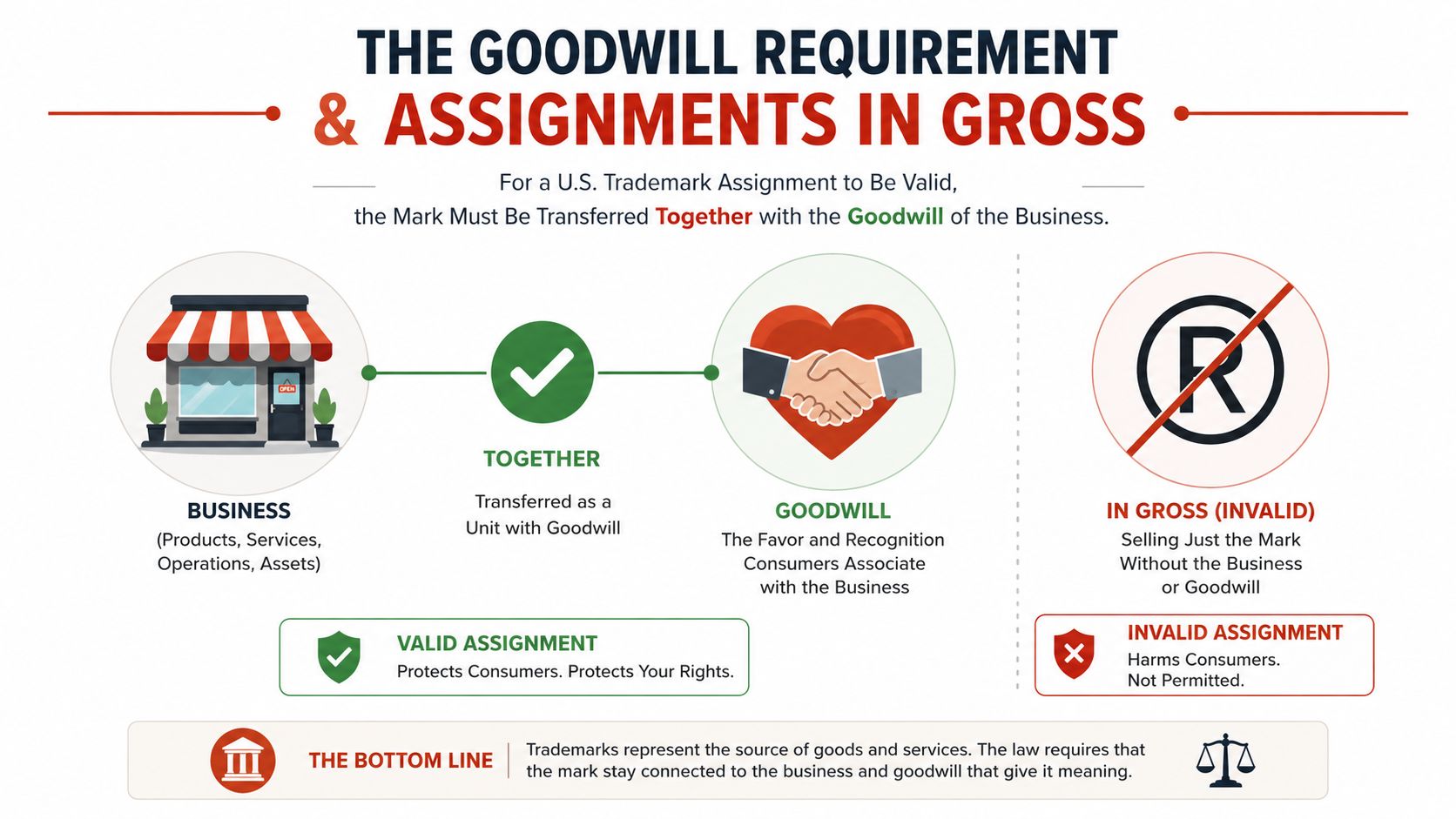
A trademark is more than a word or logo. It points to the source quality consumers expect, and U.S. law treats that source significance as bound up with the business's goodwill. An assignment that separates the mark from that goodwill is vulnerable as an assignment in gross. The USPTO assignment FAQ and INTA discussion of in gross transfers both treat goodwill as part of a valid transfer.
What goodwill means in practice
Goodwill is the consumer association between the mark and the business, not a line item for stock or equipment. In a restaurant sale, for example, transferring the mark while leaving the buyer without recipes, supplier relationships, the operating site, or the continuity customers recognise can look like a transfer of a label without the business identity behind it. That is the kind of fact pattern that invites an argument that the mark was assigned in gross.
The drafting fix is simple, but it has to match the deal. State that the goodwill is transferred, then make the surrounding transaction consistent with that statement. If the buyer is continuing the same product line, the sale should show continuity in the business assets or operations that carry the mark's source significance.
A goodwill recital helps. It does not rescue a deal that is commercially inconsistent with the mark's history.
If the transfer is challenged, the assignee will not win by pointing to one sentence in the contract. The assignee has to show continuity of use and consumer perception, and the business conduct needs to match the paper. U.S. practice takes that seriously, while other regimes handle formality differently, so cross-border deals need separate review before anyone assumes a signed agreement has transferred enforceable rights. Intent-to-use applications are a separate issue, and their transfer limits have their own statutory logic, so they should be handled carefully rather than folded into a broad sale clause.
Cross-Border Differences in Assignment Rules
A signed assignment can transfer rights in one jurisdiction while leaving gaps in another. The U.S. goodwill rule is the clearest example, but registry formalities create separate risks. Deal teams that draft for one office and reuse the document elsewhere may discover that the agreement is valid between the parties yet incomplete for recordal or ineffective against third parties.
For a U.S. transfer, the agreement should connect the mark with the business goodwill it represents. The buyer should also receive enough of the relevant business or operating continuity to support that position. A bare recital may not cure a transaction that separates the mark from the business associated with it. The agreement should identify the affected registrations or applications, the transferred goods and services, and any related assets needed to explain continuity.
EUIPO practice starts with a different formality. The assignment must be in writing and signed by both parties, even where national law might permit a less formal transfer. Recordal can be supported by sufficient evidence of the transfer, and the register provides public evidence that ownership has changed. Partial assignments are possible, but the document must identify the goods or services transferred precisely. Class headings alone may leave the scope uncertain (EUIPO assignment guidance).
India requires a separate review. Assignments may be made with or without goodwill, but local publication and filing steps can affect whether the transfer is properly reflected in the record. A common agreement can establish the commercial deal, yet it should not replace the India-specific filing process.
| Requirement | United States (USPTO) | European Union (EUIPO) | India (CGPDTM) |
|---|---|---|---|
| Validity form | Written assignment addressing goodwill | Written and signed by both parties | With or without goodwill, subject to local steps |
| Goodwill language | Supports a valid transfer and avoids an assignment in gross | No equivalent U.S. validity rule | Goodwill treatment is more flexible |
| Partial assignment | Permitted if the transferred rights are identified | Permitted with specific goods or services | Requires local filing compliance |
| Recordal focus | Chain of title and public notice | Register entry showing the changed owner | Filing and publication requirements |
| Deal risk | Mark separated from its business goodwill | Unclear scope or missing signatures | Missed filing or publication steps |
A Delaware holding company assigning a portfolio to a UK buyer therefore needs a jurisdiction-by-jurisdiction completion plan. The U.S. instrument should address goodwill, the EUIPO recordal should define any partial transfer, and the Indian process should be checked locally. One agreement can provide the commercial foundation. It cannot make the registries interchangeable.
Recording the Assignment with the USPTO
A signed agreement can still leave a buyer exposed if the USPTO record does not identify the transfer clearly. The Assignment Center now handles trademark assignment recordations through the newer electronic platform. Its scale also shows why small filing errors matter. The USPTO maintains a substantial historical record of assignments and related transactions, so the public record must support a clean chain of title.
What the filing needs
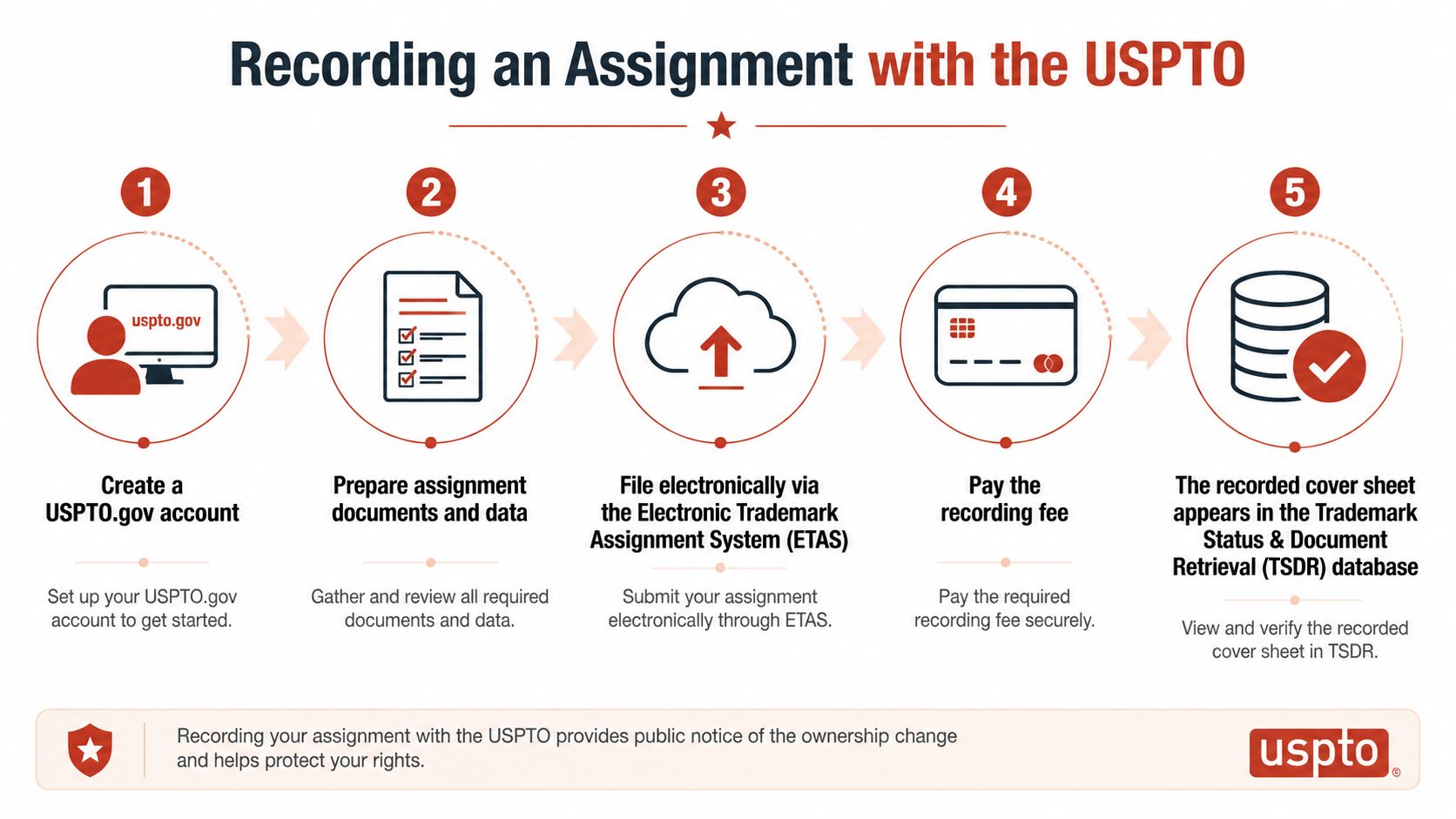
Start with the cover sheet. The recordation submission needs the conveying party, receiving party, nature of the interest, relevant registration or application numbers, correspondence details, and execution date. The USPTO accepts true copies rather than requiring the original, but the submission must be legible. Electronic filing through the USPTO assignment system is encouraged because it can speed processing (USPTO assignment FAQ).
Rejections often arise from details that should have been checked before submission. The owner names on the cover sheet should match the USPTO record. Select the correct conveyance type, verify that serial numbers correspond to the intended applications, include the required signatures, and make sure the supporting agreement can be read. A poor scan can delay recordation because the Office cannot infer missing or unclear terms.
Recordation tip: make the cover sheet and executed agreement mirror each other before filing.
The working sequence is straightforward. Prepare the signed agreement, enter the exact owner details, attach the supporting legal document, pay the recording fee, and review the resulting entry in the trademark database. If the Office identifies a defect, address it promptly. Leaving a defective record unresolved can interrupt the chain of title during an acquisition, financing, or enforcement review.
The database may not display the changed ownership information and prosecution history immediately after notice of recordation. USPTO guidance allows up to seven days for that information to appear. Keep the filing confirmation, then check the relevant application or registration record after that period. A recorded assignment is useful only when the public entry matches the transaction the parties signed.
Sharing and Tracking Executed Agreements Securely
After signing and recordation, the executed agreement becomes a core chain-of-title document. Buyers, lenders, auditors, and outside counsel may request it during diligence, and they need the signed version, not a later redraft circulated by email. Uncontrolled attachments create version confusion and leave no reliable record of who received the document.
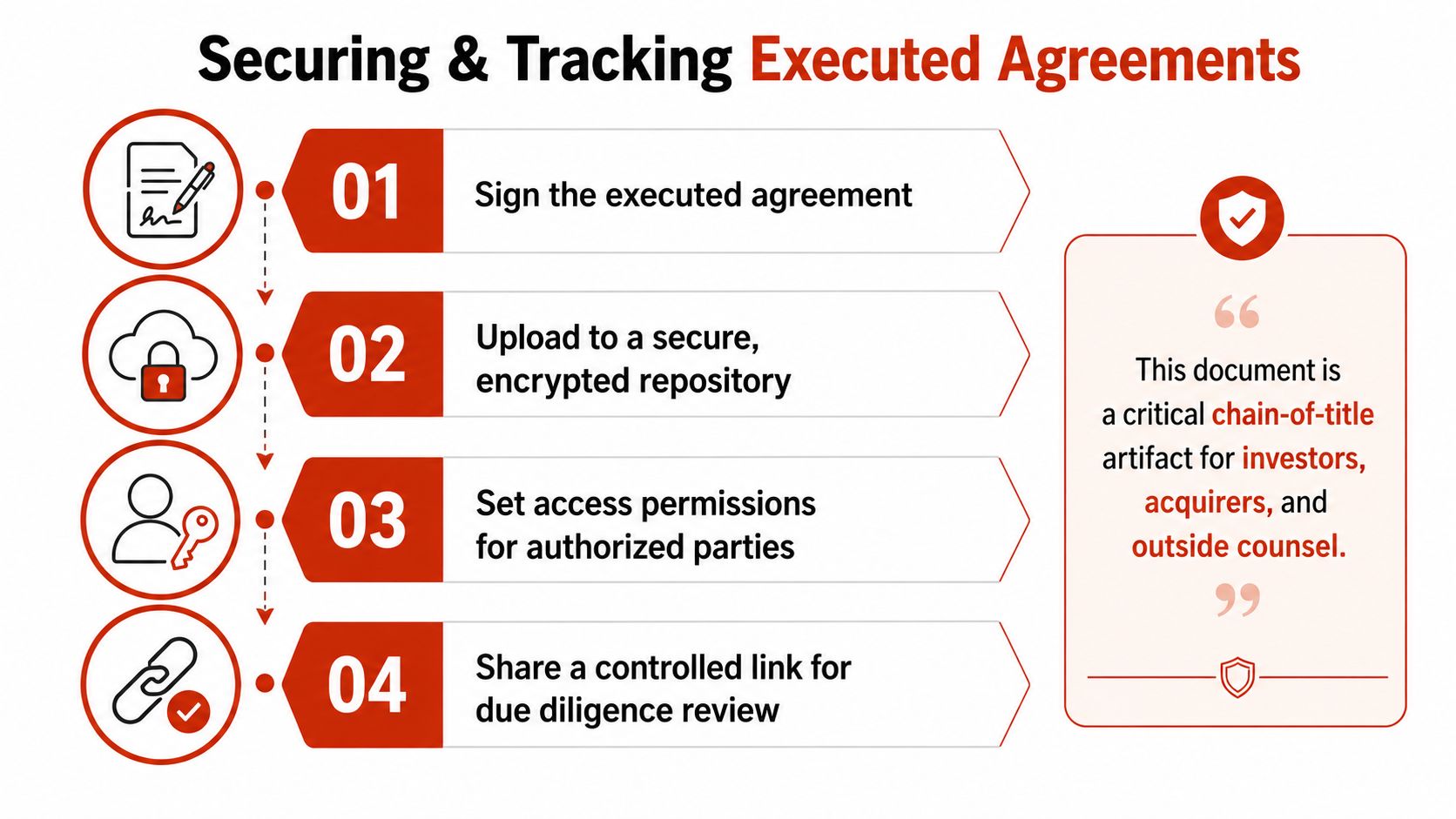
Keep the final agreement in a controlled repository and share a durable link instead of repeatedly sending the file. This preserves version control, limits unnecessary exposure of commercial terms such as consideration, and creates an access trail if someone later asks who reviewed the document and when. Because the USPTO does not return originals, each party must preserve its own copy for the life of the chain of title.
A controlled link also lets a founder answer a diligence request without opening the entire deal folder. Investor counsel can receive access to the assignment record, executed agreement, and recording confirmation through one permissioned workspace rather than through several inboxes. The objective is durable document control, with access settings that can be reviewed and withdrawn when appropriate. Secure PDF sharing with controlled access can support a traceable-link workflow when teams need something more reliable than another attachment in circulation.
Retention and metadata that help later
Store the file with the registration number, jurisdiction, execution date, and both parties' names in the filename and metadata. This makes it clear which version was signed and whether it concerns the USPTO mark, the EU registration, or the Indian filing. Keep the agreement, signature evidence, access history, and recordation confirmation together, while preserving the original file format.
Timestamped access logs can show who reviewed the document before closing, during diligence, or after a challenge arose. They also help distinguish an authorised disclosure from an informal copy sent outside the transaction team.
A useful archive is one counsel can retrieve quickly without searching email threads. Consistent naming and permissions reduce delays when someone requests the chain of title on short notice. Review access rights periodically so former advisers or deal participants do not retain unnecessary access to the executed agreement.
Common Mistakes That Invalidate Transfers
The mistakes that cause the most pain are usually simple, not exotic. Teams rush the signature block, reuse a generic asset sale clause, and assume the filing will sort itself out later. Later is when the registry rejects the recordation or the buyer finds out the assignment is vulnerable in litigation.
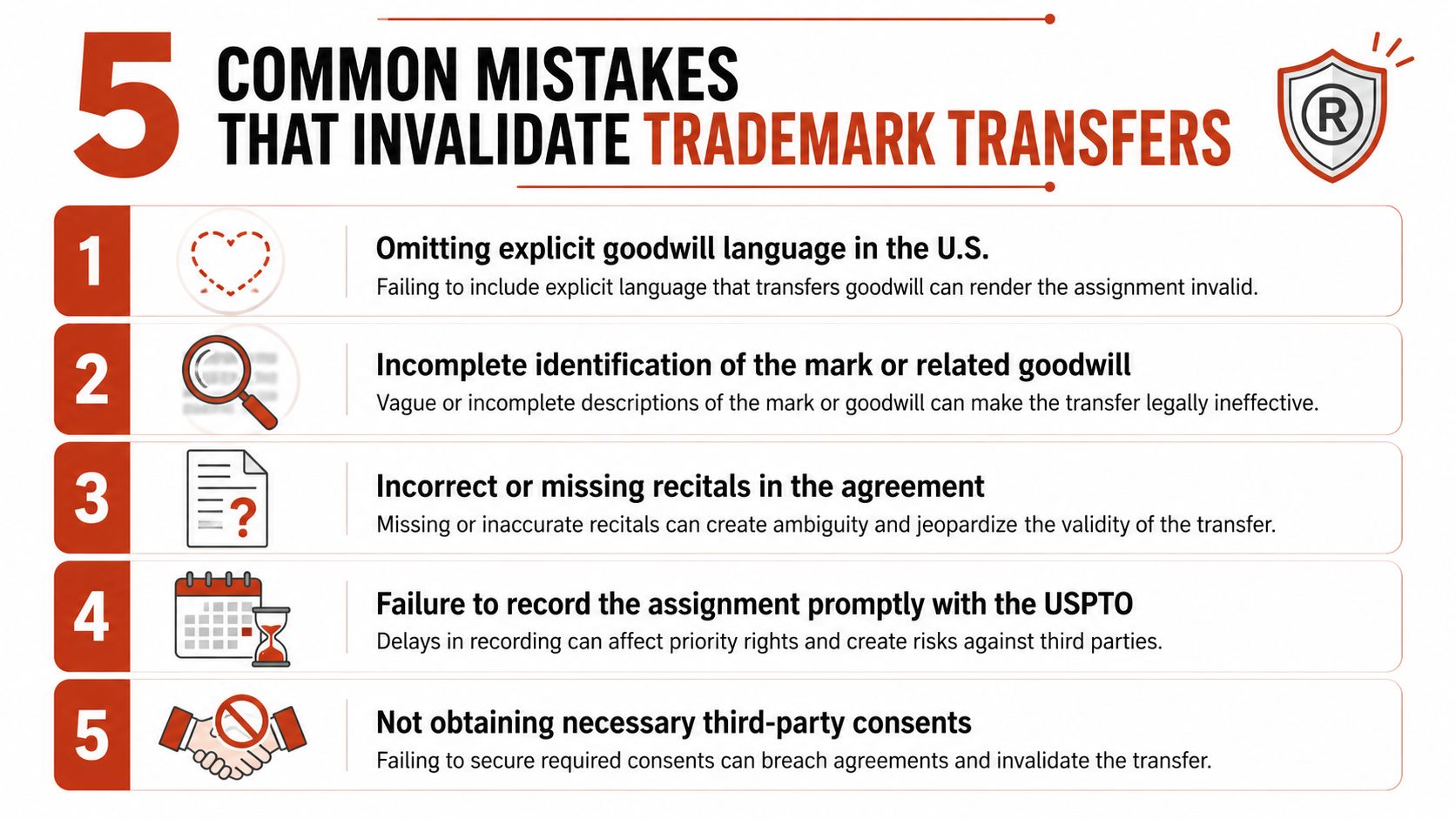
The five failures that show up again and again
-
No explicit goodwill language in a U.S. transfer. That turns the deal into an argument over an assignment in gross, which can leave the mark vulnerable. The fix is to say the goodwill is conveyed and make the business conduct match.
-
Names that do not match the owner-of-record data. The USPTO compares the cover sheet to the record, and mismatches trigger rejection. The fix is to verify the exact legal names before signing.
-
Missing local formalities outside the U.S. India may require its own witness, notarisation, or filing discipline depending on the form and the transaction path. The fix is to check the local recordation steps before anyone signs.
-
Blanket “all IP” wording with no registration numbers. That leaves the scope fuzzy and can create avoidable disputes later. The fix is to enumerate each mark, application, or registration.
-
Signed paperwork that never gets recorded. That leaves the buyer with a contract but weak priority against later buyers and lienholders. The fix is to assign responsibility for filing at closing, not after the closing binder has been archived.
A transfer can fail at the registry even when every commercial party thinks the deal is done.
That's why careful teams treat the filing as part of the deal, not as admin after the deal. If the agreement is meant to survive diligence, enforcement, and a future transaction, the document set has to be clean on day one.
Self-destructing links are not the answer for assignment records. The signed agreement and the proof of recordation should remain available on a controlled basis for as long as the chain of title needs them.
Quick-Reference Checklist and Cross-References
A trademark assignment gets much easier when the team checks each item against the registry that will read it. This is the fastest way to catch mismatches between what the contract says and what the office will accept. It also keeps the record straight when the same transfer touches more than one country.
Before signing, confirm the current owner of record, any security interest, and whether the mark is registered, pending, or part of a larger portfolio. Then make the agreement do four things well, identify the mark, state the transfer, preserve the goodwill position required in the U.S., and specify who files the recordation package. After execution, check the filing status and keep the final version indexed by registration number and jurisdiction. PDF tracking for executed agreements helps teams keep that file trail organised when multiple counsel are involved.
| Checklist Item | USPTO Requirement | EUIPO Requirement | India TMR Requirement |
|---|---|---|---|
| Verify owner of record | Match cover sheet to TSDR record | Check current register entry | Confirm current proprietor |
| Identify the mark precisely | Registration or application number | Trade mark number(s) | Application or registration number |
| Transfer wording | Strong grant language, plus goodwill | Written and signed transfer | Local transfer wording and filing steps |
| Scope of transfer | Enumerate each mark clearly | Partial assignment must specify goods or services | Identify the marks and related scope |
| Execution formalities | Signatures, legible true copy | Signed by both parties | Local execution formalities may apply |
| Recordation package | Cover sheet and supporting document | Recordal entry on the register | Local filing form and publication steps |
| Post-closing follow-up | Confirm recordation appears | Confirm register update | Confirm local filing status |
That checklist is not a substitute for legal review, but it catches the errors that cost the most time. A founder sending a brand to a buyer, or an in-house team moving a portfolio between affiliates, should be able to print it, mark it up, and file from it without guessing which office wants what.
EveryPage gives you a controlled way to share executed trademark assignments, recordation confirmations, and diligence packs without losing track of who opened what. If you're managing a transfer and want durable links, page-level reader analytics, and no reader accounts, visit EveryPage and use it to keep the title file clean while the deal moves forward.
See who reads your next PDF.
Try EveryPage free