Example of Quasi Contract: Key Court Rulings
Nick · Published 9 August 2026
You've sent a proposal, delivered a design set, or covered an urgent fix, then the other side starts treating the work as if the agreement never mattered. That's where an example of quasi contract becomes useful, because the law can step in when someone has taken a benefit and refuses to pay for it, even without a signed agreement.
For business students, the idea feels simple once you strip away the jargon. A court is not pretending there was a real contract. It is forcing repayment or compensation to stop unjust enrichment, which is the core fairness problem behind these cases.
Table of Contents
- When the Law Steps In Without a Signed Agreement
- Understanding Quasi Contract and Its Legal Foundations
- Classic Examples of Quasi Contract in Action
- Modern Digital Disputes and Platform-Mediated Mistakes
- Quasi Contract Versus Express and Implied Contracts
- Key Takeaways and Practical Considerations
When the Law Steps In Without a Signed Agreement
A freelancer finishes a rush assignment on a Friday night because the client says the deck has to go out before Monday's investor meeting. The client uses the deck, the meeting happens, and then the invoice gets questioned because “there was no signed contract.” That is the kind of dispute that pushes people towards quasi-contract reasoning.
The law's response is blunt. If one side clearly got the benefit of the work, and keeping that benefit without paying would be unfair, a court can impose an obligation even though nobody formally assented to a contract. The point is not to punish the client for being difficult. The point is to stop the client from keeping value that was plainly received.
Why business people run into this
This comes up far beyond freelancer disputes. A founder may ask for help with a pitch deck, a consultant may start work before paperwork is signed, or a client may accept emergency repairs and then argue over price later. In each setting, the legal question is less about labels and more about whether the recipient kept a benefit at someone else's expense.
Practical rule: if the other side used the work, goods, or service, and there's no enforceable agreement covering that exact subject matter, quasi-contract can become the fallback theory.
That is why the doctrine matters in ordinary commercial life. It gives courts a way to say, “you can't take the value and walk away from the bill,” even when the paper trail is thin. It also helps explain why people often recover under restitution or quantum meruit rather than breach-of-contract damages.
Understanding Quasi Contract and Its Legal Foundations
A quasi contract arises when a court imposes a duty to prevent unjust enrichment, even though the parties never reached mutual assent. In practical terms, the law treats money, goods, or services as something that should be paid for when one side has received a benefit in circumstances that make retention without payment unfair.
The three things courts look for
Courts usually focus on three linked ideas. First, one party conferred a benefit. Second, the other party appreciated or knowingly accepted that benefit. Third, it would be inequitable to let the recipient keep it without payment. Those are the working parts of the claim, and they keep the doctrine tied to fairness rather than formal contract formation.
The historic roots are old. The English case Moses v. Macferlan was decided in 1760, and later summaries treat it as an early common-law statement that someone who received money under a mistake of fact could be required to repay it, even without a contract between the parties. The legal idea behind it is restitutionary, not contractual. That distinction still shapes how modern courts talk about quasi-contract claims today. Foundational summary of Moses v. Macferlan and unjust enrichment
Why it is usually restitution, not breach damages
A breach-of-contract claim says, “we had an agreement, you broke it, pay me for the loss.” A quasi-contract claim says, “we never formed a real agreement, but you still should not keep this benefit for free.” That is why the remedy is usually restitution or quantum meruit, which aim to return the value of what was received rather than enforce promised performance.
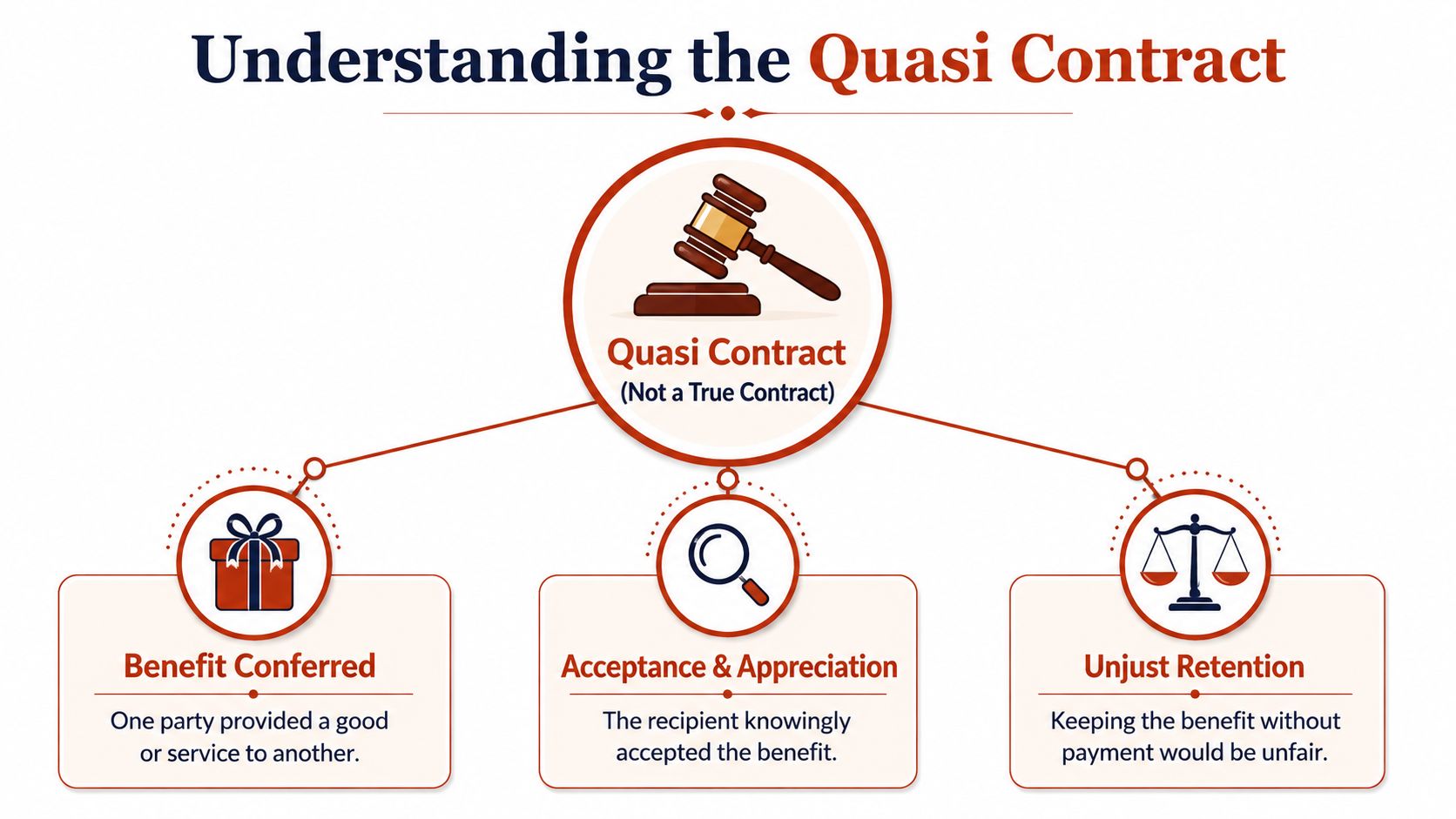
A useful way to remember it is this. A real contract comes from assent. A quasi contract comes from fairness. That difference matters in business disputes because the paper record may be incomplete, the payment may have gone through a platform, or the mistake may have crossed borders. A mistaken digital transfer, a marketplace refund error, or a service fee charged in the wrong jurisdiction can all raise the same basic question, whether one side retained value that should be returned.
Courts also pay attention to who caused the problem and who kept the benefit. A merchant who receives payment through a platform glitch, or a vendor who is paid in the wrong currency and keeps the extra amount, may face a restitution claim even if no one signed a fresh agreement. The same idea can appear in a cross-jurisdiction dispute, where the parties did not choose the same legal forum and the court must first decide whether the enrichment claim fits the governing rules. The doctrine gives judges a way to correct a one-sided benefit without pretending a full contract existed.
The legal system is not rewarding loose paperwork. It is correcting a one-sided benefit.
Classic Examples of Quasi Contract in Action
The clearest way to understand an example of quasi contract is to watch it operate in a real dispute. The best-known teaching examples all share the same structure. Someone receives a valuable benefit, the provider does not get paid, and the court decides that retention without payment would be unjust.
Medical care that had to be paid for
A major U.S. teaching example comes from 1980, when Mary Dobos received about one month of around-the-clock nursing care after an abdominal aneurism. The court ordered restitution of $3,723.90 even though she had not expressly approved the services. That case is often used to show that necessary services can create liability under quasi-contract principles when the recipient is clearly enriched and the care was life-saving. Mary Dobos quasi-contract example
The lesson is not that every unapproved service becomes payable automatically. The lesson is that emergency or necessary help can still have legal value, especially when the recipient plainly benefited and the provider expected compensation rather than a gift.
Work started, then cancelled
Another common illustration is the moving-help scenario. Person A verbally offers Person B $100 to help move. B relies on that promise and turns down other work. A then cancels after B has already shown up. If a court accepts the claim, it may order payment even though no formal contract was signed, because B gave up time and opportunity in reliance on the proposed deal. Practical quasi-contract illustration
Services knowingly accepted
The salon example is even more direct. A customer asks for a trim but knowingly receives a more expensive full service haircut, wash, and highlights, then refuses to pay. Because the customer knew the service was being provided and benefited from it, restitution may be required.
The same logic appears in the Weichert Co. Realtors v. Ryan example. The broker collected property information, carried documents between the parties, and gave negotiating help, while the buyer repeatedly refused to sign a commission agreement and later offered partial payment rather than the expected commission tied to a $3 million sale price. The case is useful because it shows how a court can focus on measurable benefit and missing enforceable agreement at the same time. Weichert Co. Realtors v. Ryan quasi-contract example
Modern Digital Disputes and Platform-Mediated Mistakes
The old examples usually involve cash, food, repairs, or medical care. Today, many disputes start inside apps, payment rails, and marketplaces, where mistakes can be created by software rather than by a person at a desk. The legal idea is the same, though the evidence looks different.
When the mistake is electronic
Think about accidental transfers, duplicate invoice payments, subscription overcharges, or marketplace fulfilment that sends the wrong item to the wrong buyer. In each case, the question is whether the recipient can keep the benefit after noticing the error. If the recipient knows the money or service was delivered by mistake and keeps it anyway, the unjust-enrichment argument gets much stronger.
A frequent point of confusion is that people search for “quasi contract” when they really need a restitution analysis. That distinction matters because the doctrine is not a real agreement. It is a remedy for unjust enrichment, and U.S. federal practice often frames it that way instead of treating quasi-contract as a standalone contract theory. Justice Department summary of quasi-contractual claims
What digital systems change
Digital systems make proof more technical, not less important. A recipient may say, “the payment just appeared,” but the payer may have logs, timestamps, account records, and cancellation requests that show the transfer was accidental. Courts then look at the same basic ideas as before, namely benefit conferred, knowledge or appreciation of the benefit, and whether keeping it would be unfair.
Evidence matters: prompt notice, account records, and proof that the recipient understood the payment or delivery was mistaken can matter more than the label attached to the transaction.
This is also where modern privacy tools become relevant for people sharing sensitive documents or billing records. If you need to show a disputed invoice, a client proof, or a payment history, you want a system that supports controlled access without adding unnecessary data exposure. GDPR-friendly PDF tracking practices can matter here in a broader operational sense, even though the legal doctrine itself stays focused on restitution.
The deeper point is simple. Quasi-contract is old, but its setting is modern. Software can create the mistake, yet the fairness question stays the same.
Quasi Contract Versus Express and Implied Contracts
A quasi-contract claim usually enters the picture after a court sees that a valid agreement is missing, incomplete, or too far away from the dispute to do the work. A signed form, a phone call, or a course of dealing may already create a real contract, so the first task is to identify which legal category fits the facts.
Side by side differences
| Contract Type | Formation | Mutual Assent | Remedy | When It Applies |
|---|---|---|---|---|
| Express contract | Clear words, written or oral | Yes | Contract damages or agreed remedies | The parties agreed on terms |
| Implied-in-fact contract | Conduct shows agreement | Yes, inferred from behaviour | Contract remedies | The parties acted as if they had a deal |
| Quasi contract | A court-imposed duty arising when one side receives a benefit and retaining it would be unfair | No | Restitution or quantum meruit | One side received a benefit and keeping it would be unfair |
Section 70 of the Indian Contract Act 1872 gives a concrete statutory version of this logic. If a person lawfully does something for another person, or delivers something to them, without intending it to be gratuitous, and the other person enjoys the benefit, the recipient must compensate the provider or restore the thing delivered. The source also gives a mistake-delivery example involving chocolates sent to the wrong person, eaten, and then not paid for. Section 70 explanation and examples
Why the distinction affects the claim
That distinction matters because quasi-contract generally will not be imposed if an express or implied-in-fact contract already covers the same subject matter. In practice, a court may reject an unjust-enrichment theory if the parties already have a valid agreement governing payment, scope, or delivery. Cornell Law's quasi-contract overview)
The Weichert example shows the border line well. The broker had done substantial work, but the court still had to ask whether there was an enforceable agreement for the commission. That question mattered because quasi-contract is a backup route, not a shortcut around a real contract.
Digital payments make the distinction feel less abstract. A transfer can land in the wrong wallet, a platform can route a payout to the wrong seller account, or a client can send money after a subscription or service relationship has already ended. In those settings, the legal question stays the same. Was there a real agreement covering the transfer, or did one side receive a benefit that needs to be restored through restitution?
Cross-jurisdiction issues can add another layer. A business student looking at a payment error between accounts in different countries may assume the label alone decides the case, but courts usually start with the governing agreement, the forum, and the local restitution rule. That is why a platform's terms matter, and why a dispute can turn on EveryPage terms even before the court reaches the fairness analysis.
If you are sorting a live dispute, the safest question is not “what sounds fairest?” It is “is there already a valid agreement that covers this exact work?” That question often decides whether you plead breach of contract, unjust enrichment, or both in the alternative.
Key Takeaways and Practical Considerations
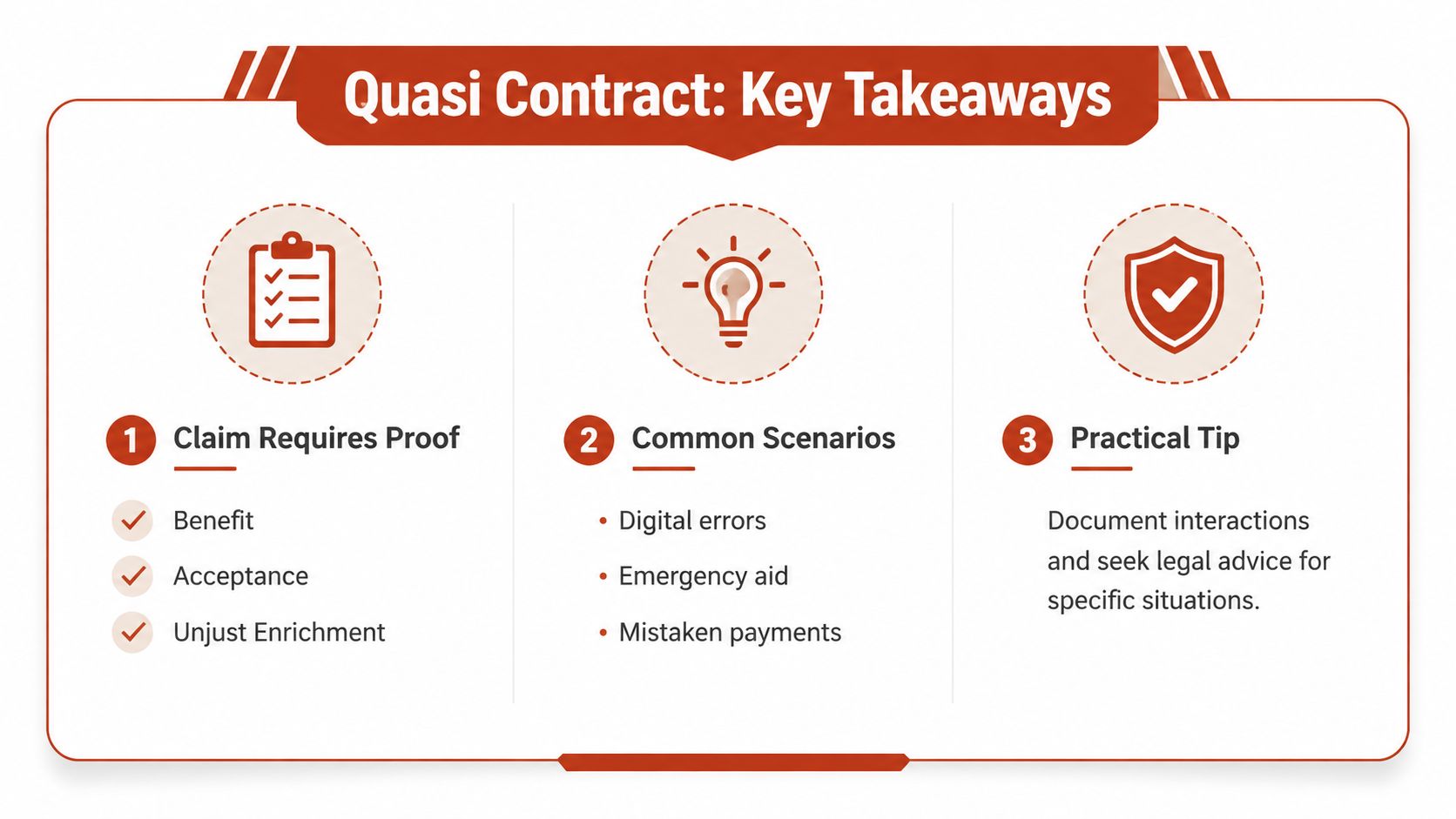
The cleanest example of quasi contract is still the same across sectors. One party confers a benefit, the other party accepts or uses it, and keeping it without payment would be unfair. That can happen with emergency medical care, a rushed design job, a mistaken delivery, or a digital transfer sent to the wrong account.
What to remember
- Benefit first: ask whether the recipient got something useful.
- Acceptance matters: look for knowledge, use, or clear retention of the benefit.
- Unfair retention is the trigger: if keeping it would be inequitable, restitution becomes plausible.
Jurisdiction matters too. Common-law courts and statutory systems can describe the doctrine differently, even when they are trying to stop the same kind of unjust enrichment. That is why a broad internet answer can feel helpful and still miss the actual legal test in your situation.
The practical habit that helps most is simple. Document what was provided, when it was provided, who requested it, and how the other side responded. That record is often the difference between a clean restitution claim and a vague dispute about who meant what.
For teams that share proposals, proofs, invoices, or policy documents, protecting the record is part of avoiding the dispute in the first place. Security, encryption, and privacy details matter when you need a defensible audit trail without overexposing reader data.
If you need to share a proposal, proof set, or invoice trail and want a clearer record of who opened what, EveryPage lets you track reader engagement without requiring an account for the viewer. It's a practical fit for documents that need to stay durable and up to date, and you can see how it works at EveryPage.
See who reads your next PDF.
Try EveryPage free